
Garden & Outdoor
The 3 Best Cordless Leaf Blowers of 2026, Tested by SAVEN
A good cordless leaf blower should clear a driveway in minutes, shift wet leaves off the lawn without a fight, and do it all without a cord, a fuel can, or a sore shoulder. We compared the leading battery platforms on the criteria that actually decide a purchase: clearing power, real-world runtime, weight, noise, and how much the batteries cost you over time.
The six blowers below cover every type of yard, from a small patio that needs a five-minute tidy to a leaf-heavy acre that used to demand a gas machine. Whichever battery platform you may already own matters more than ever, so we have flagged where a blower makes the most sense as part of a bigger tool system — and where it stands on its own.
Our Top Picks
- EGO Power+ LB6504 — Best Overall
- Ryobi 40V HP Brushless Blower — Best Value
- Greenworks Pro 80V Blower — Most Powerful
1. EGO Power+ LB6504
Best Overall
SAVEN Score: 4.8 / 5
The EGO Power+ LB6504 is the cordless blower we would hand to almost anyone with a typical suburban yard. Its brushless motor moves up to 650 CFM, with air speeds up to 180 MPH on turbo — enough to lift wet, matted leaves off grass and push gravel back off a driveway. A variable-speed trigger and cruise-control dial make it easy to feather the power around flower beds, and the included flat and tapered nozzles cover both wide clearing and focused work. Runtime depends heavily on speed, but the 5.0Ah 56V battery in the kit, at around $300, gives generous working time at moderate settings and recharges on the same platform as EGO's mowers and trimmers.
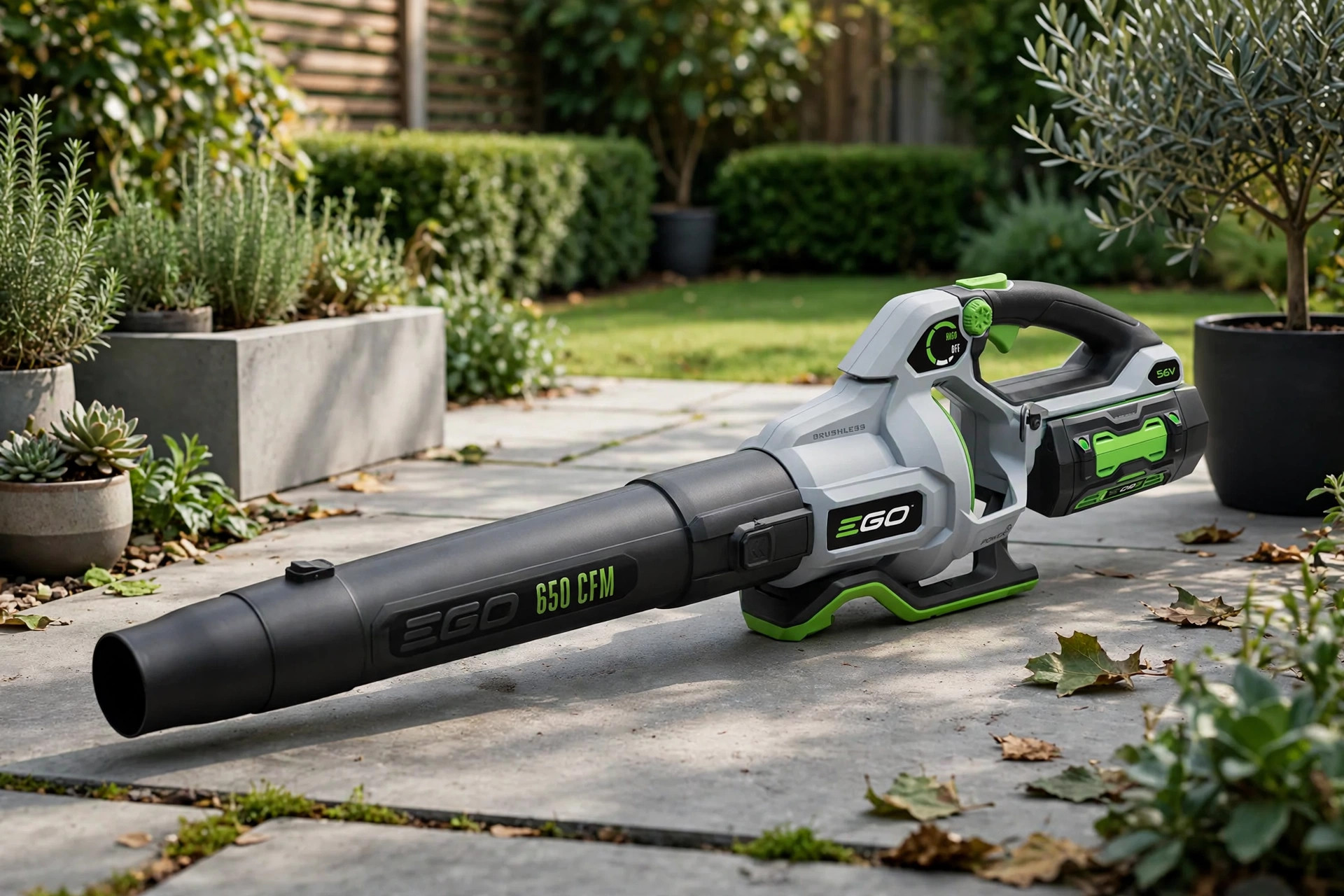
- Up to 650 CFM; up to 180 MPH on turbo
- 56V ARC Lithium platform; 5.0Ah battery in most kits
- Variable-speed trigger with cruise control
What we like
- Strong, well-rounded clearing power
- Comfortable, precise speed controls
- Large and growing 56V tool ecosystem
What to consider
- Noticeably heavy with the 5.0Ah pack fitted
- Turbo mode drains the battery quickly
2. Ryobi 40V HP Brushless Blower
Best Value
SAVEN Score: 4.5 / 5
Ryobi's 40V HP brushless blower delivers performance that used to cost considerably more — the kit typically sells for around $200. It is rated at up to 730 CFM with air speeds around 160 MPH, and a turbo button provides a short burst for stubborn piles. The brushless motor keeps efficiency up, while a cruise-control lever saves your trigger finger on long driveway sessions. Two things stand out at this price: the controls feel a step above budget blowers, and the 40V battery also runs Ryobi's large range of outdoor tools, so existing owners can buy the bare tool and save more. It is not the quietest blower here, and the casing is mostly plastic, but the value equation is hard to beat.
- Up to 730 CFM; around 160 MPH air speed
- 40V HP brushless motor
- Turbo button and cruise-control lever
What we like
- Excellent power for the price
- Huge, affordable 40V tool lineup
- Simple, comfortable controls
What to consider
- Mostly plastic construction
- Gets loud at full speed
3. Greenworks Pro 80V Blower
Most Powerful
SAVEN Score: 4.6 / 5
If raw clearing power is the priority, the Greenworks Pro 80V is the strongest blower in this roundup. Its brushless axial-fan design is rated at up to 700 CFM and 170 MPH — enough to move wet leaves, pine needles, and light debris that stall lesser blowers. The variable trigger and cruise control help meter that output, and the 80V platform's larger batteries suit long sessions on bigger properties. Kits usually land around $250. The trade-offs are noise and weight at full throttle, plus a smaller tool ecosystem than some rivals. For large yards where cordless models once felt like a compromise, this is the one that feels like a genuine gas replacement.
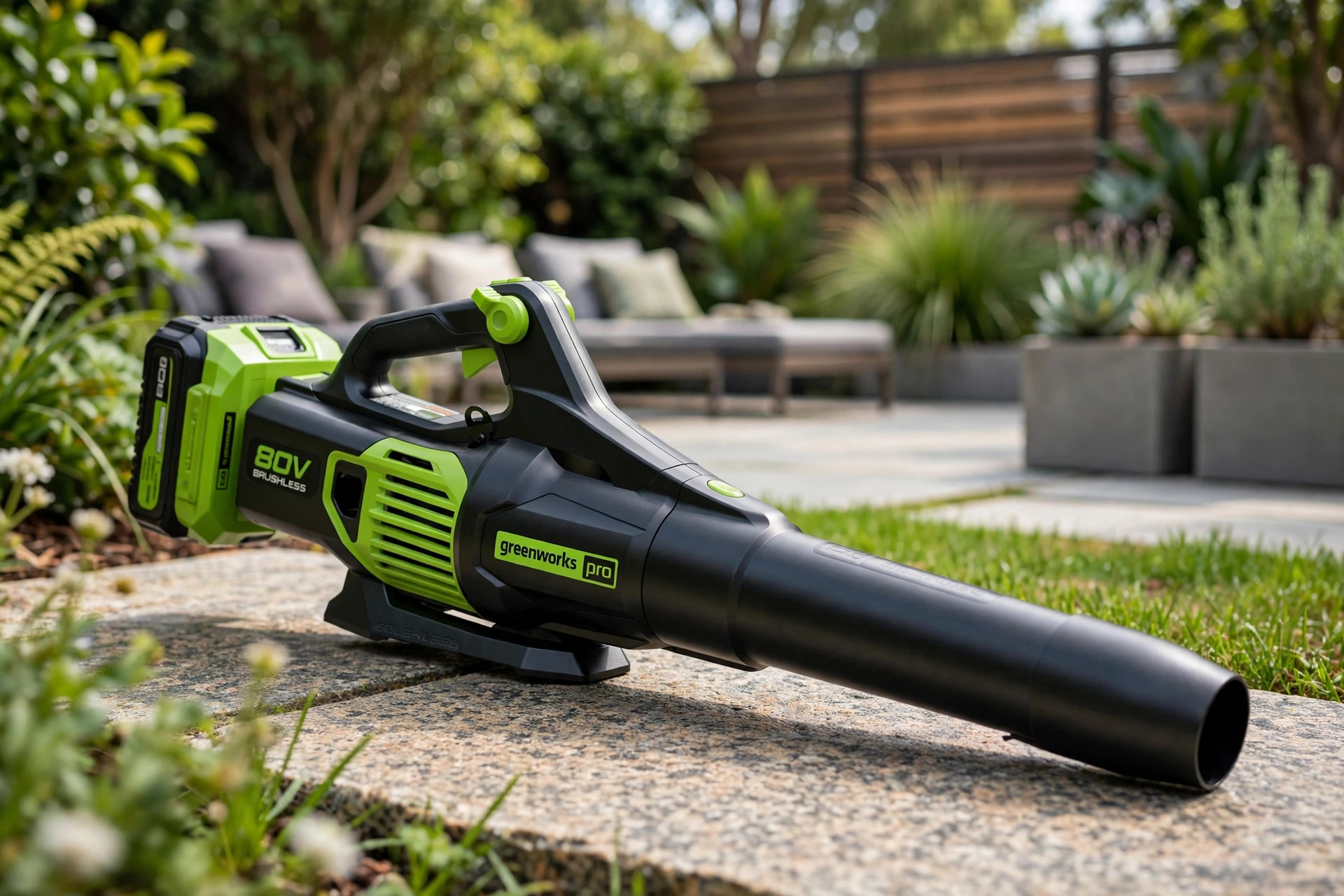
- Up to 700 CFM; up to 170 MPH air speed
- 80V brushless axial-fan design
- Variable trigger with cruise control
What we like
- Top-tier clearing power for heavy debris
- Strong runtime from larger 80V packs
- Feels like a true gas alternative
What to consider
- Loud and heavy at full throttle
- Smaller accessory and tool ecosystem
What to Look For in a Cordless Leaf Blower
Start with the two power numbers. CFM (cubic feet per minute) describes how much air the blower moves, and it is what carries a pile of leaves across the yard; MPH describes how fast that air travels, which is what pries stuck, wet debris loose. For most homes, a balance of both — roughly 450 CFM or more with speeds above 110 MPH — covers everything from dust on the patio to autumn leaf fall. Next, think platform before product: batteries are the expensive part, so a blower that shares packs with tools you own, or plan to own, is almost always the smarter buy. Check the rated runtime at realistic speeds rather than the headline figure, and try the tool's weight with its largest battery fitted, since that is how you will actually carry it. Brushless motors are worth having for efficiency and longevity. Finally, consider noise — ratings and designs vary widely — and small comforts like cruise control and interchangeable nozzles, which matter more over a long cleanup than any single spec.
Frequently Asked Questions
Which matters more, CFM or MPH?
They do different jobs. CFM moves volume, so it carries loose leaves and debris across open ground; MPH provides the force that lifts wet, stuck material. For general yard work, prioritize CFM first, then check that air speed is at least around 110 MPH so the blower can still scour pavement and damp patches.
How long does a cordless blower battery actually last?
It depends heavily on speed. Expect long, useful runtimes at low settings for dust and dry grass, but only a fraction of that on turbo. If your sessions regularly run past half an hour of heavy clearing, budget for a second battery or choose a platform whose larger packs you can share with other tools.
Can a cordless blower handle wet leaves?
Yes, within reason. Higher-CFM models with a turbo mode can move wet, matted leaves, especially if you work in layers and use a concentrator nozzle to get under the pile. For very large properties with heavy fall coverage, a high-voltage model from this list — or a second battery — makes the job far more manageable.